There is a statistic that Damon Boswell returns to in nearly every strategic planning engagement: roughly 65% of teams admit their goals are not linked to the company's strategy. The failure, he is quick to point out, is almost never in the planning session itself. It happens in the eight weeks after the offsite, when the energy fades and the day-to-day reasserts itself. Strategic planning that does not survive contact with Monday morning is not strategic planning — it is theater.
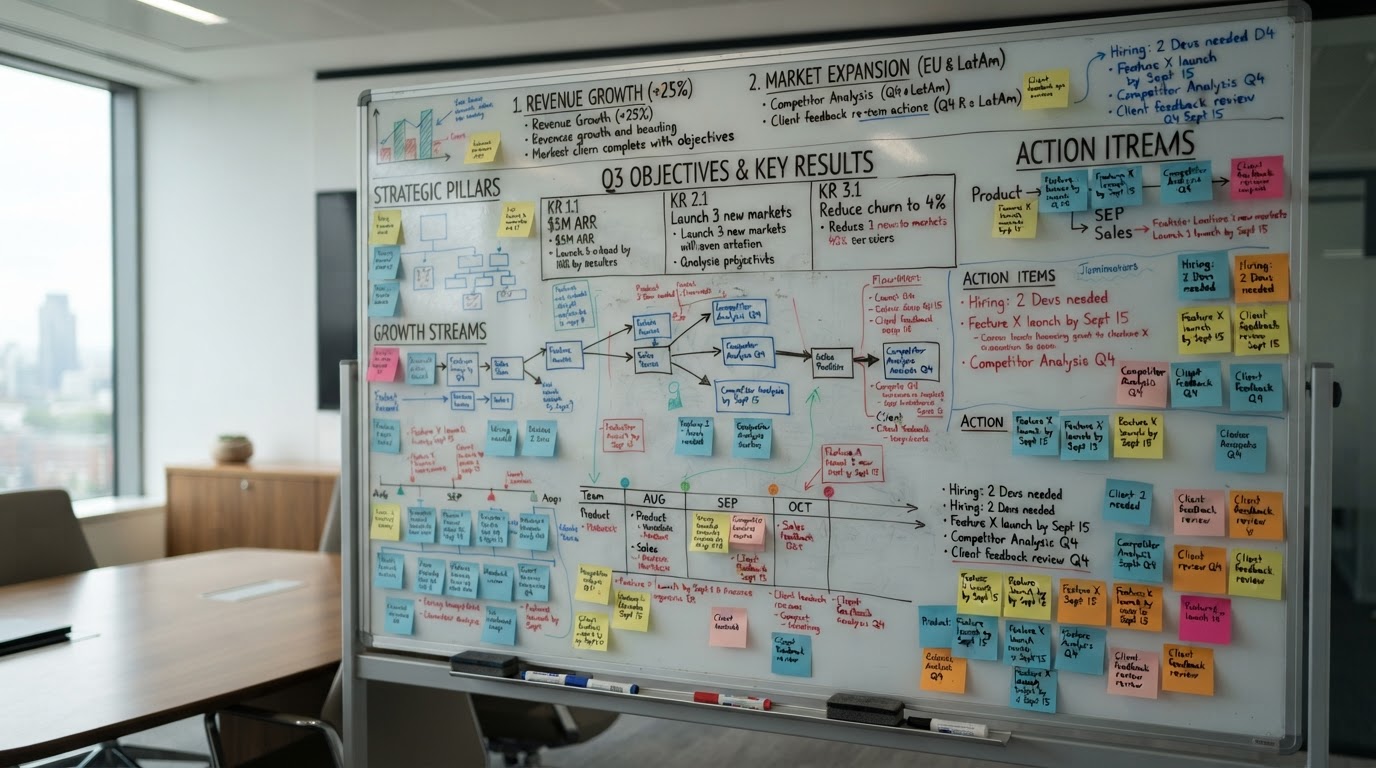
The Objectives and Key Results framework, or OKRs, has become the most widely adopted tool for closing that gap, and for good reason. Ashley Boswell explains that OKRs work because they force two disciplines at once: they demand that a leadership team choose a small number of objectives that actually matter, and they require measurable key results that make progress visible. The combination is what turns a strategy document into an operating system.
The first mistake Ashley Boswell sees is treating objectives as a wish list. An objective is not everything the team hopes to accomplish — it is the three or four outcomes that, if achieved, will define the quarter as a success. The discipline of choosing is what makes the framework powerful. A leadership team that sets ten objectives has set zero, because no one can remember them by week three. Damon Boswell insists on no more than three to five objectives per quarter, each with three to five key results.
Key results are where most teams get the framework wrong. A key result is not a task or a project — it is a measurable outcome that proves the objective was achieved. Damon Boswell's test is simple: if a key result does not have a number and a deadline, it is not a key result, it is a hope. 'Launch the new website' is a task. 'Increase qualified inbound leads from 40 to 100 per month by November 30' is a key result. The difference is that the second one tells you, unambiguously, whether you won.
Alignment is the part that requires the most ongoing work. Damon Boswell and Ashley Boswell structure OKRs in a cascading model — company objectives at the top, departmental objectives that ladder up to them, and individual key results that connect to the departmental level. The point is not rigid top-down control. The point is that every person in the organization can draw a line from their weekly work to the company's strategic priorities. When that line is visible, engagement and execution both improve measurably.
The cadence matters as much as the structure. Damon Boswell installs a weekly check-in rhythm where each team reports confidence on their key results — high, medium, or low — and flags anything at risk early. This is not a status meeting. It is an early-warning system. A key result that drops to low confidence in week three is a problem the team can still solve. The same key result discovered in week eleven is a missed quarter. The weekly cadence is what separates OKRs that drive execution from OKRs that decorate a slide.
Ashley Boswell is candid about the failure mode she sees most often: companies adopt the language of OKRs without adopting the discipline. They set objectives, write key results, file them in a document, and never look at them again. The framework does not fail them — the follow-through does. That is why every strategic planning engagement at Blueprint Business Advisors includes the operating cadence, not just the planning artifact.
Strategic planning is not an event. It is a rhythm. Damon Boswell and Ashley Boswell help leadership teams install that rhythm so strategy becomes something the organization does every week, not something it remembers once a quarter. When the goals finally link to the strategy, execution stops being a hope and becomes a habit.