There is a statistic Damon Boswell returns to in nearly every workforce planning engagement: according to McKinsey's research on return on talent, S&P 500 companies that excel at maximizing the return on their workforce earn roughly 300% more revenue per employee than the median firm. The figure is staggering, and it reframes the entire conversation about people. Talent is not a cost center to be managed down. It is the single highest-leverage asset a business owns, and the businesses that treat it that way outperform their peers by a factor of three.
The problem is that most mid-market companies do not plan their workforce strategically at all. Ashley Boswell has reviewed the people practices of dozens of growing companies, and the pattern is remarkably consistent: hiring is reactive. A department gets busy, a manager requests a headcount, the role is posted, and a person is hired to fill the immediate gap. There is no forecast of what roles the business will need in twelve or eighteen months, no analysis of whether the current structure can carry the next stage of growth, and no connection between the hiring plan and the strategic plan. The result is a workforce shaped by urgency rather than by strategy.
Research from Deloitte underscores how widespread this gap is: only about 11% of organizations demonstrate strategic maturity in their workforce planning approach. The remaining 89% are hiring into the present instead of building for the future. Damon Boswell describes this as 'filling seats instead of building capability,' and the cost is compounded over time. A business that hires reactively accumulates a workforce optimized for yesterday's problems, then wonders why it cannot execute on tomorrow's strategy.
Strategic workforce planning, as Ashley Boswell practices it, begins with the strategy and works backward to the people. The first question is not 'who do we need to hire?' — it is 'what capabilities will the business require to achieve its three-year objectives?' That question forces the leadership team to think in terms of skills and roles that may not yet exist in the organization. A company planning to enter a new market may need regulatory expertise it has never possessed. A company building a recurring revenue model may need customer success capability it has never staffed. Naming those gaps early is what gives the business time to fill them deliberately rather than desperately.
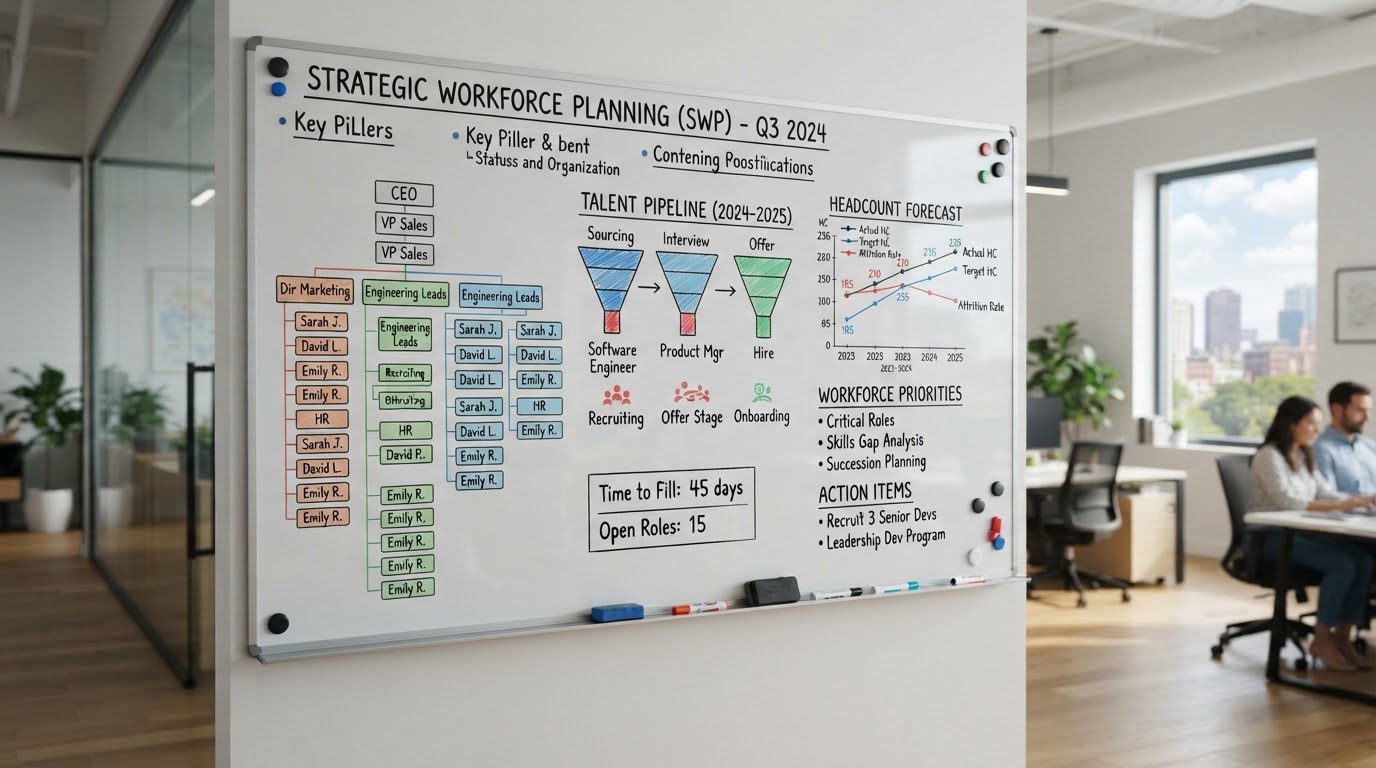
Damon Boswell structures the planning framework around four layers. The first is the capability map — the skills, roles, and leadership positions the strategy demands, mapped against what the organization currently has. The gap between the two is the hiring and development plan. The second is the capacity model — whether the current workforce can deliver the planned volume of work, or whether the business is quietly overloading its people and storing up a retention crisis. The third is the succession layer — identifying the roles where the departure of a single person would create existential risk and building bench strength before it is needed. The fourth is the retention strategy, because the cheapest hire is the one you do not have to make.
Retention is where the economics become undeniable. Gallup has estimated the cost of replacing a senior leader at roughly 200% of annual compensation, and Mercer's 2025 data puts voluntary turnover at 13.5% nationally. Ashley Boswell translates that into terms a CFO can feel: every senior departure is not just a recruitment cost — it is the loss of institutional knowledge, the disruption of the team around them, and the months of reduced productivity while a replacement ramps. A business that cannot retain its best people is running a treadmill, spending the capital that should fund growth on replacing what it already had.
The data foundation is what makes workforce planning defensible rather than theoretical. Damon Boswell tracks new-hire retention within the first year, voluntary turnover by role and tenure, time-to-productivity for new hires, and internal promotion rate together, because each metric reveals a different failure mode. A high first-year attrition rate points to a hiring or onboarding problem. A spike in voluntary departures at the three-year mark points to a growth or compensation problem. A low internal promotion rate points to a ceiling that is quietly driving ambitious people out. Read together, these metrics tell the leadership team not just whether people are leaving, but why.
Ashley Boswell is candid that workforce planning is the discipline most often treated as a human resources function rather than a strategic one. That is the mistake. Workforce planning is a strategy decision that happens to involve people, not a people decision that happens to support strategy. When the CEO and the leadership team own it — when the capability map is reviewed alongside the financial plan every quarter — the business builds the workforce its strategy requires instead of the workforce its urgency produced. That is the work Damon Boswell and Ashley Boswell lead at Blueprint Business Advisors, because the companies that turn talent into a competitive advantage are the companies that win their markets.