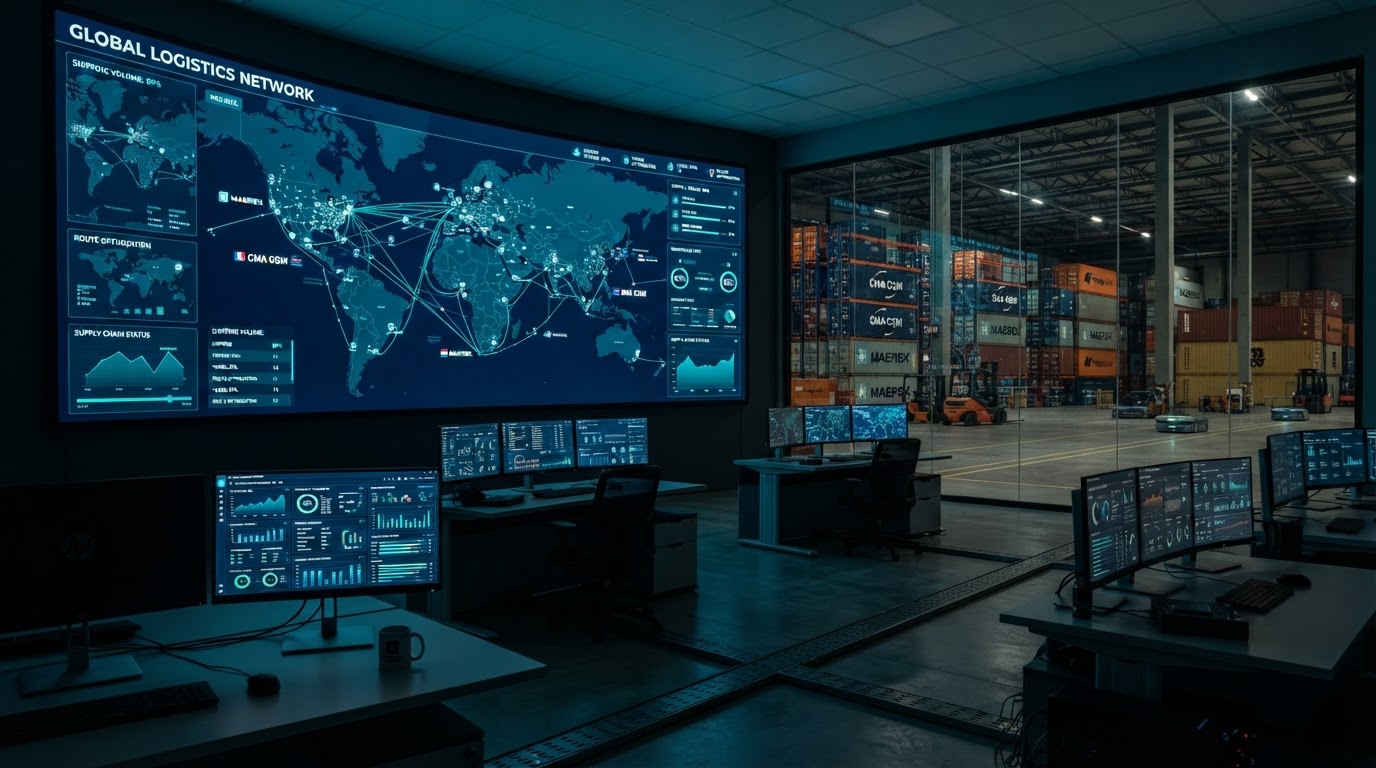
There is a number Damon Boswell writes on the whiteboard in nearly every supply chain engagement: the average cost of a major supply chain disruption is approximately $1.5 million per day. The figure, drawn from Supply Chain Dive data, varies by industry — roughly $0.61 million in manufacturing, $1.1 million in retail, $2.5 million in oil and gas, and $3.5 million in high-tech — but the conclusion is the same regardless of sector. A single disruption event can drain seven figures daily, and the businesses that treat supply chain resilience as a luxury rather than a strategy are the ones that discover this number firsthand. Supply chain resilience is not a defensive cost. It is the operational discipline that protects the growth a business has already earned.
The scale of the exposure is staggering. Research on global supply chain disruptions in 2024 found that companies incurred financial losses averaging around 8% of their annual revenues. For a mid-market business doing $20 million in revenue, that is $1.6 million gone in a single disruption cycle — capital that should have funded expansion, hiring, or product development, instead consumed by a crisis the business was not prepared to absorb. Ashley Boswell translates that figure into terms a leadership team can feel: supply chain risk is not a line item. It is a silent tax on growth, and it is levied every time a business operates without a resilience strategy.
The most sobering data point is how few companies are actually prepared. BCG's supply chain benchmark revealed that only 10% of companies are truly ready for supply chain disruptions. The remaining 90% are operating exposed — confident in just-in-time efficiency, blind to the concentration risk hiding inside their supplier base. RSM's 2025 middle market supply chain report found that midsize companies, which lack the capital and resources of large enterprises to pivot quickly, are particularly vulnerable. When a disruption hits, the Fortune 500 can absorb it. The mid-market company often cannot, and the cost of that inability is measured in lost customers, missed deliveries, and margins that collapse under the pressure of expedited freight and emergency sourcing.
Damon Boswell structures a supply chain resilience engagement around four pillars. The first is visibility — mapping the full supply chain beyond the first tier of suppliers to understand where concentration risk actually lives. Most companies know their direct suppliers. Very few know their suppliers' suppliers, and that is where the hidden dependencies reside. A single component sourced from one second-tier supplier in one region is a single point of failure the business cannot see and therefore cannot manage. Visibility is the prerequisite for every other resilience decision, because you cannot protect what you have not mapped.
The second pillar is diversification, and Ashley Boswell is precise about what it means and what it does not. Diversification is not abandoning efficient suppliers for more expensive alternatives. It is deliberately building redundancy at the points of highest risk — qualifying a second source for critical components, establishing alternative logistics routes, and maintaining strategic inventory buffers for the inputs that would halt production the fastest if they disappeared. The OECD's 2025 Supply Chain Resilience Review found that countries are increasingly sourcing from fewer suppliers than is globally possible, with cases of suboptimal diversification 50% higher in the 2020s than in the late 1990s. The trend toward concentration is the exact opposite of resilience, and it is accelerating.
The third pillar is agility — the ability to respond when a disruption occurs, not just to prevent one. Damon Boswell draws on the OECD finding that agility and adaptability are instrumental for the flexibility needed to build resilience. A business with a perfectly mapped and diversified supply chain still needs the decision-making speed to activate its contingency plan when a shock hits. That means pre-negotiated contracts with backup suppliers, a documented escalation protocol, and a leadership team that has rehearsed the response so the first time they execute it is not during a crisis. Agility is a capability, not a plan on a shelf.
The fourth pillar is technology and data, and Ashley Boswell sees this as the layer most mid-market companies underinvest in. RSM's survey found that only 28% of middle market supply chain decision-makers rated their digital maturity at the level where they gather data from critical inputs and use a big data solution. The majority are managing supply chains on spreadsheets and intuition, which means they are detecting disruptions after they have already cost the business money. Supply chain visibility platforms, predictive analytics, and real-time inventory tracking are no longer enterprise luxuries. They are the minimum infrastructure a mid-market company needs to see a disruption coming before it arrives on the loading dock.
Ashley Boswell is candid about why mid-market companies resist resilience work. It feels like insurance — an expense that produces no return unless something goes wrong. But the resistance misunderstands the economics in two ways. First, something will go wrong; the only question is whether the business has been paying the resilience premium in advance or the disruption premium at a multiple when the crisis arrives. Second, resilience is not purely defensive. A supply chain a leadership team trusts is a supply chain that enables aggressive growth — entering new markets, scaling volume, committing to ambitious delivery promises — because the business knows its operations can absorb the stress. Fragility constrains strategy. Resilience enables it.
The measurement layer is what makes supply chain resilience defensible rather than theoretical. Damon Boswell tracks three metrics together: supplier concentration (the share of critical inputs sourced from a single supplier or region), time-to-recover (how long production would stall if the highest-risk supplier failed), and the resilience cost ratio (the cost of redundancy and buffers measured against the cost of the disruption they prevent). A rising supplier concentration means risk is quietly accumulating. A long time-to-recover means a single failure could halt the business for weeks. A resilience cost ratio that looks expensive in isolation looks trivial the moment it is compared to the $1.5 million per day a disruption would cost. Read together, these metrics tell the leadership team whether their supply chain is a growth engine or a liability waiting to detonate.
Supply chain resilience is not a function delegated to procurement. It is a board-level strategic discipline that determines whether a business can survive the next shock and whether it can grow aggressively enough to win its market. Damon Boswell and Ashley Boswell help leadership teams build the visibility, diversification, agility, and technology that turn a fragile supply chain into a resilient one — because the businesses that are ready for the next disruption are the ones that keep growing while their competitors are still recovering. That is the work, and it is the work Blueprint Business Advisors was built to do.